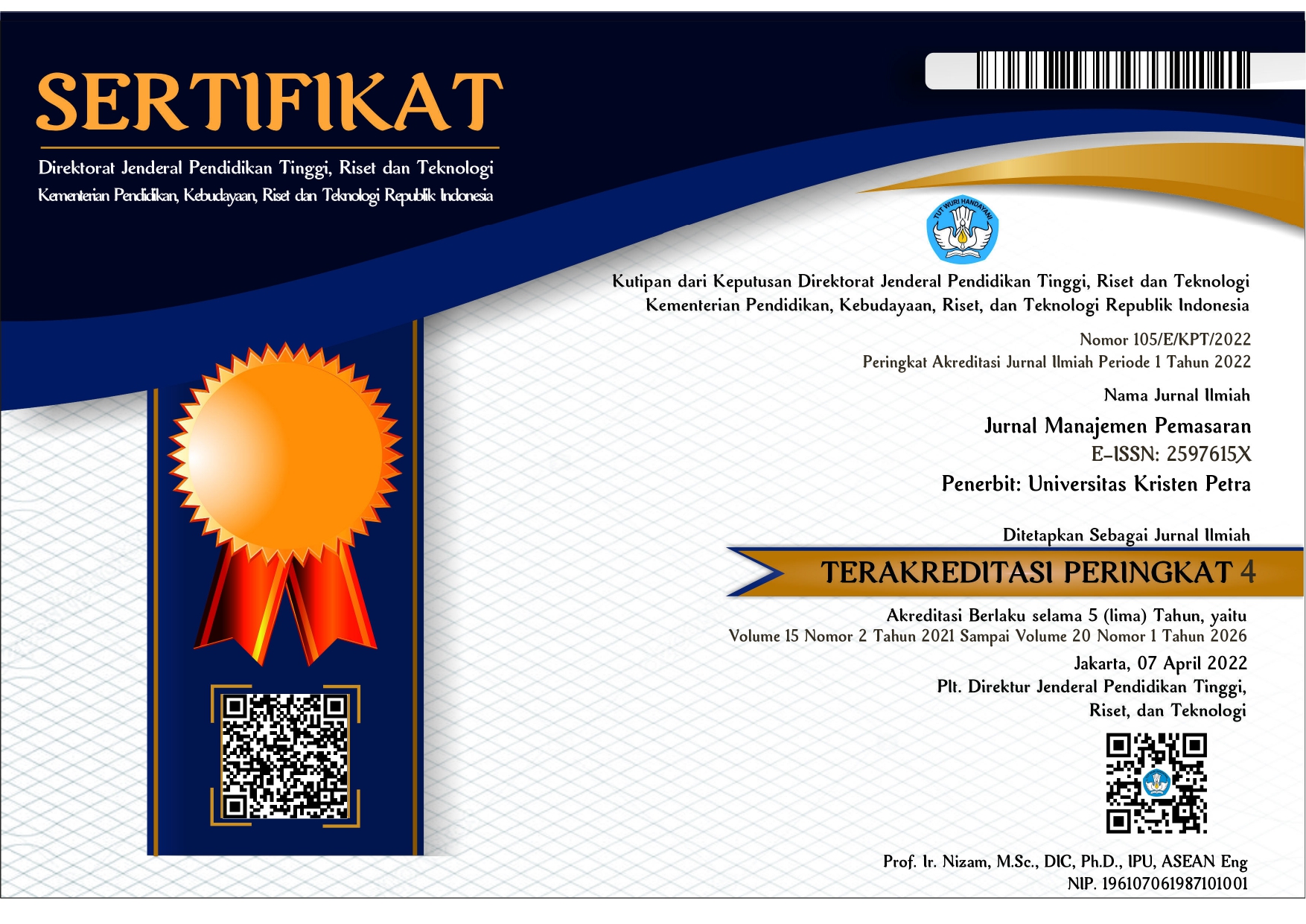
Efek Moderasi Health Consciousness pada Pengaruh Digital Nudging Terhadap Behavioral Intention Pengguna McDelivery
DOI:
https://doi.org/10.9744/pemasaran.20.2.%25pKeywords:
behavioral intention, digital nudging, gen z, health consciousness, online food delivery, self-licensingAbstract
Interaksi konsumen dengan platform online food delivery (OFD) membuat mereka terpapar berbagai digital nudging, seperti pesan pop-up yang menawarkan promosi penjualan terbatas dan rekomendasi menu makanan. Dengan mengambil McDelivery sebagai objek studi, penelitian ini menganalisis pengaruh digital nudging terhadap behavioral intention serta peran moderasi health consciousness di dalamnya. Data berasal dari survei online pada April 2026 terhadap 215 responden Gen Z di Surabaya. Penelitian ini menggunakan PLS-SEM untuk analisis data. Hasil penelitian menunjukkan bahwa digital nudging meningkatkan behavioral intention pengguna McDelivery. Menariknya, health consciousness memiliki sifat moderasi yang kontraintuitif. Alih-alih memperlemah, health consciousness justru memperkuat efektivitas digital nudging tersebut. Penelitian ini menawarkan mekanisme self-licensing sebagai kemungkinan penjelasannya bahwa konsumen yang sadar kesehatan mungkin menggunakan digital nudging sebagai "izin moral" untuk melanggar rutinitas diet mereka sesekali.
Downloads
References
Alam, M. M. D., Hussain, K., Nusair, K., & Momotaz, S. N. (2025). Understanding user behaviors toward food delivery app services: The moderating effects of generation and usage frequency. Journal of Hospitality and Tourism Insights. Advance online publication. https://doi.org/10.1108/JHTI-10-2024-1148
Badan Pusat Statistik Kota Surabaya. (2025). Jumlah penduduk menurut kelompok umur dan jenis kelamin (ribu jiwa) di Kota Surabaya 2024. https://surabayakota.bps.go.id/id/statistics-table/3/WVc0MGEyMXBkVFUxY25KeE9HdDZkbTQzWkVkb1p6MDkjMw==/jumlah-penduduk-menurut-kelompok-umur-dan-jenis-kelamin--ribu-jiwa--di-kota-surabaya--2024.html?year=2024
Bagozzi, R.P., Wong, N., Abe, S. and Bergami, M. (2000). Cultural and situational contingencies and the theory of reasoned action: application to fast food restaurant consumption. Journal of Consumer Psychology, 9(2), 97-106. https://doi.org/10.1207/S15327663JCP0902_4
Bartczak, K., & Łobejko, S. (2021). An innovative model for measuring attitudes towards digital technology platforms. European Research Studies Journal, 24(3B), 249–270. https://doi.org/10.35808/ersj/2461
Databoks. (2024, February 20). Indonesia pasar online food delivery terbesar di Asia Tenggara. https://databoks.katadata.co.id/infografik/2024/02/20/indonesia-pasar-online-food-delivery-terbesar-di-asia-tenggara
Deshpande, S., Basil, M.D. and Basil, D.Z. (2009). Factors influencing healthy eating habits among college students: an application of the health belief model. Health Marketing Quarterly, 26(2), 145-164. https://doi.org/10.1080/07359680802619834
Eroglu, S. A., Machleit, K. A., & Davis, L. M. (2001). Atmospheric qualities of online retailing: A conceptual model and implications. Journal of Business Research, 54(2), 177–184. https://doi.org/10.1016/S0148-2963(99)00087-9
Espinosa, A., & Kadić-Maglajlić, S. (2018). The mediating role of health consciousness in the relation between emotional intelligence and health behaviors. Frontiers in Psychology, 9, Article 2161. https://doi.org/10.3389/fpsyg.2018.02161
Esposito, G., Hernández, P., Van Bavel, R., & Vila, J. (2017). Nudging to prevent the purchase of incompatible digital products online: An experimental study. PLoS ONE, 12(3), Article e0173333. https://doi.org/10.1371/journal.pone.0173333
GoodStats. (2024). Gen Z paling rajin konsumsi media, daya fokus paling rendah. https://goodstats.id/article/gen-z-paling-rajin-konsumsi-media-daya-fokus-paling-rendah-yHpHz
Grant, K., Hollywood, L., Simmons, G., Bucher, T., & Burns, A. (2025). Nudging and food shopping: A review of technological interventions within the grocery environment. Critical Reviews in Food Science and Nutrition. Advance online publication. https://doi.org/10.1080/10408398.2025.2530548
Hair, J. F., Hult, G. T. M., Ringle, C. M., & Sarstedt, M. (2017). A primer on Partial Least Squares Structural Equation Modeling (PLS-SEM) (2nd ed.). SAGE Publications.
Hair, J. F., Risher, J. J., Sarstedt, M., & Ringle, C. M. (2019). When to use and how to report the results of PLS-SEM. European Business Review, 31(1), 2–24. https://doi.org/10.1108/EBR-11-2018-0203
Huang, H. L. (2023). Challenges for contactless online food delivery services during the COVID-19 pandemic in Taiwan: Moderating effects of perceived government response. Evaluation and Program Planning, 97, Article 102249. https://doi.org/10.1016/j.evalprogplan.2023.102249
Jatimnet. (2021, March 15). Gen Z dominasi jumlah penduduk, saatnya ekonomi Jatim bangkit. https://jatimnet.com/generasi-z-dominasi-jumlah-penduduk-saatnya-ekonomi-jatim-bangkit
Jesse, M., Jannach, D., & Gula, B. (2021). Digital nudging for online food choices. Frontiers in Psychology, 12, Article 729589. https://doi.org/10.3389/fpsyg.2021.729589
Katadata Insight Center. (2021, June 10). Survei KIC: Ada tiga layanan digital yang semakin banyak dipakai Gen Z. Katadata. https://katadata.co.id/berita/nasional/60c0385836fd9/survei-kic-ada-tiga-layanan-digital-yang-semakin-banyak-dipakai-gen-z
Kaur, P., Dhir, A., Talwar, S., & Ghuman, K. (2020). The value proposition of food delivery apps from the perspective of theory of consumption value. International Journal of Contemporary Hospitality Management, 33(4), 1129–1159. https://doi.org/10.1108/IJCHM-05-2020-0477
Kemp, S. (2025, February 27). Digital 2025: Indonesia. DataReportal. https://datareportal.com/reports/digital-2025-indonesia
Khalufi, N. A. M. (2025). Digital nudges and environmental concern in shaping sustainable consumer behavior aligned with SDGs 12 and 13. Sustainability, 17(24), Article 11292. https://doi.org/10.3390/su172411292
Kompasiana. (2022, January 1). Online food delivery semakin digemari masyarakat. https://www.kompasiana.com/rahmawatieka7061/61d088c306310e2ab91bf2e4/online-food-delivery-semakin-digemari-masyarakat
Kraus, S., Jones, P., Kailer, N., Weinmann, A., Chaparro-Banegas, N., & Roig-Tierno, N. (2021). Digital transformation: An overview of the current state of the art of research. SAGE Open, 11(3), 1–15. https://doi.org/10.1177/21582440211047576
Kunto, Y. S., & Bras, H. (2019). Ethnic group differences in dietary diversity of school-aged children in Indonesia: The roles of gender and household SES. Food and Nutrition Bulletin, 40(2), 182–201. https://doi.org/10.1177/0379572119842993
Lau, T. C., & Ng, D. C. Y. (2019). Online food delivery services: Making food delivery the new normal. Journal of Marketing Advances and Practices, 1(1), 1–16. https://www.researchgate.net/publication/334050513_Online_Food_Delivery_Services_Making_Food_Delivery_the_New_Normal
McDonald’s Indonesia. (2023). McDonald’s Indonesia raih Top Digital Company Award 2023. https://www.mcdonalds.co.id/whats-on/mcdonalds-indonesia-raih-top-digital-company-award-2023
McKinsey & Company. (2020). Understanding and shaping consumer behavior in the next normal. https://www.mckinsey.com/capabilities/growth-marketing-and-sales/our-insights/understanding-and-shaping-consumer-behavior-in-the-next-normal
Mehrabian, A., & Russell, J. A. (1974). An approach to environmental psychology. The MIT Press.
Muangmee, C., Kot, S., Meekaewkunchorn, N., Kassakorn, N., & Khalid, B. (2021). Factors determining the behavioral intention of using food delivery apps during covid-19 pandemics. Journal of Theoretical and Applied Electronic Commerce Research, 16(5), 1297–1310. https://doi.org/10.3390/jtaer16050073
Osaili, T. M., Al-Nabulsi, A. A., Taybeh, A. O., Ismail, L. C., & Saleh, S. T. (2023). Healthy food and determinants of food choice on online food delivery applications. PLoS ONE, 18(10), Article e0293004. https://doi.org/10.1371/journal.pone.0293004
Poon, W. C., & Tung, S. E. H. (2024). The rise of online food delivery culture during the COVID-19 pandemic: An analysis of intention and its associated risk. European Journal of Management and Business Economics, 33(1), 54–73. https://doi.org/10.1108/EJMBE-04-2021-0128
Prabowo, G. T., & Nugroho, A. (2019). Factors that influence the attitude and behavioral intention of Indonesian users toward online food delivery service by the Go-Food application. In Proceedings of the 12th International Conference on Business and Management Research (ICBMR 2018) (pp. 222–228). Atlantis Press. https://doi.org/10.2991/icbmr-18.2019.34
Unilever Food Solutions. (2026). Konsumen makin menghendaki transparansi. Foodreview Indonesia. https://foodreview.co.id/blog-8001-Konsumen-Makin-Menghendaki-Transparansi.html
Velings, C. (2024). Flipping the menu: Nudging sustainable food choices online by using a default nudge [Master's thesis, Tilburg University]. Tilburg University Research Portal. https://arno.uvt.nl/show.cgi?fid=178679
Wiastuti, R. D., Prawira, O., Lusyana, L., Lestari, N. S., Masatip, A., & Ngatemin, N. (2022). The relationship between convenience motivation, attitude, and behavioral intention of food delivery applications’ users. GeoJournal of Tourism and Geosites, 41(2), 548–554. https://doi.org/10.30892/gtg.41228-862
Downloads
Published
Issue
Section
License
Copyright (c) 2026 Shonia Octariana, Dylan Dave Valentino, Adriana Aprilia, Fransisca Andreani, Yohanes Sondang Kunto

This work is licensed under a Creative Commons Attribution 4.0 International License.
Jurnal Manajemen Pemasaran allows the author(s) to hold the copyright withour restrictions and retain the publishing rights without restrictions.