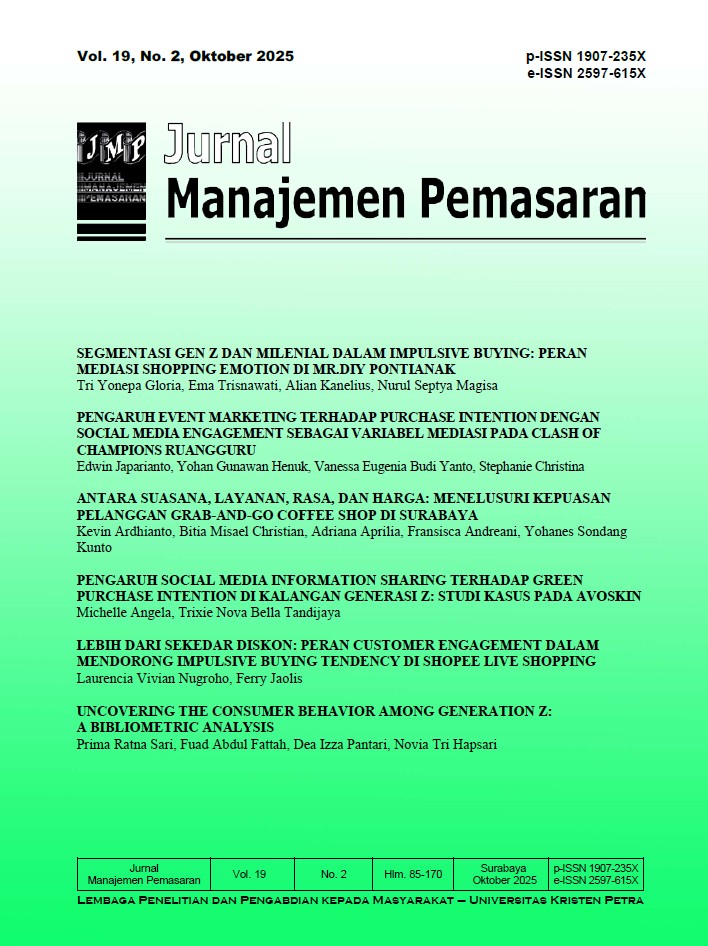
LEBIH DARI SEKEDAR DISKON
PERAN CUSTOMER ENGAGEMENT DALAM MENDORONG IMPULSIVE BUYING TENDENCY DI SHOPEE LIVE SHOPPING
DOI:
https://doi.org/10.9744/pemasaran.19.2.149-160Keywords:
product information quality, customer engagement, deal proneness, impulsive buying tendency, live shopping, Shopee liveAbstract
Penelitian ini menginvestigasi hubungan antara Product Information Quality, Customer Engagement, Deal Proneness, dan Impulsive Buying Tendency dalam konteks live shopping. Melalui metode survei menggunakan self-administered questionnaire didistribusikan melalui pesan media sosial, 160 respon diperoleh dan dapat diolah. Teknik analisa Structural Equation Modeling menggunakan metode Partial Least Square memberikan bukti empiris bahwa Product Information Quality tidak berpengaruh langsung terhadap Impulsive Buying Tendency, yang mengindikasikan peran mediasi sempurna Customer Engagement. Deal Proneness juga tidak memoderasi pengaruh Customer Engagement terhadap Impulsive Buying Tendency.
References
Badgaiyan, A. J., Verma, A., & Dixit, S. (2016). Impulsive buying tendency: Measuring important relationships with a new perspective and an indigenous scale. IIMB Management Review, 28(4), 186-199. https://doi.org/10.1016/j.iimb.2016.08.009
Barcelona, A. B., Angeles, R. J. G., Clemente, C. A., Cruz, S. R. B. D., Malimban, R. L. O., Santos, J. E. G., & Tan, J. C. D. (2022). # Budolfinds: The Role of TikTok’s Shopee Finds’ Videos in the Impulsive Buying Behavior of Generation Z Consumers. International Journal of Multidisciplinary: Applied Business and Education Research, 3(11), 2316-2328. https://doi.org/10.11594/ijmaber.03.11.18
Beatty, S. E., & Ferrell, M. E. (1998). Impulse buying: Modeling its precursors. Journal of Retailing, 74(2), 169-191. https://doi.org/10.1016/S0022-4359(99)80092-X
Blattberg, R., Buesing, T., Peacock, P., & Sen, S. (1978). Identifying the deal-prone segment. Journal of Marketing Research, 15(3), 369-377. https://doi.org/10.1177/002224377801500307
Brodie, R. J., Hollebeek, L. D., Jurić, B., & Ilić, A. (2011). Customer engagement: Conceptual domain, fundamental propositions, and implications for research. Journal of Service Research, 14(3), 252-271. https://doi.org/10.1177/1094670511411703
Chen, C. C., & Yao, J. Y. (2018). What drives impulse buying behaviors in a mobile auction? The perspective of the Stimulus-Organism-Response model. Telematics and Informatics, 35(5), 1249–1262. https://doi.org/10.1016/j.tele.2018.02.004
Chen, Y., Lu, Y., Wang, B., & Pan, Z. (2019). How do product recommendations affect impulse buying? An empirical study on WeChat social commerce. Information & Management, 56(2), 236-248. https://doi.org/10.1016/j.im.2018.09.002
Chin, W. W. (1998). The partial least squares approach to structural equation modeling. In Marcoulides, G.A. (Eds), Modern methods for business research (pp. 295-336). Psychology Press.
Coley, A. L. (2002). Affective and cognitive processes involved in impulse buying (Master Thesis]. The University of Georgia. Retrieved from https://share.google/WCuMlQG0bD41T9lbf
Creswell, J. W. (2014). Research design: Qualitative, quantitative, and mixed methods approaches (4th ed.). SAGE Publications: Thousand Oaks, California.
DelVecchio, D. (2005). Deal‐prone consumers' response to promotion: The effects of relative and absolute promotion value. Psychology & Marketing, 22(5), 373-391. https://doi.org/10.1002/mar.20064
Dessart, L., Veloutsou, C., & Morgan-Thomas, A. (2016). Capturing consumer engagement: duality, dimensionality and measurement. Journal of Marketing Management, 32(5-6), 399-426. https://doi.org/10.1080/0267257X.2015.1130738
Etikan, I., Musa, S. A., & Alkassim, R. S. (2016). Comparison of convenience sampling and purposive sampling. American Journal of Theoretical and Applied Statistics, 5(1), 1-4. https://doi.org/10.11648/j.ajtas.20160501.11
Flacandji, M., & Vlad, M. (2022). The relationship between retailer App use, perceived shopping value and loyalty: The moderating role of deal proneness. International Journal of Retail & Distribution Management, 50(8/9), 981-995. https://doi.org/10.1108/IJRDM-10-2021-0484
Hausman, A. (2000). A multi‐method investigation of consumer motivations in impulse buying behavior. Journal Of Consumer Marketing, 17(5), 403-426. https://doi.org/10.1108/07363760010341045
Hollebeek, L. D., Glynn, M. S., & Brodie, R. J. (2014). Consumer brand engagement in social media: Conceptualization, scale development and validation. Journal of interactive marketing, 28(2), 149-165. https://doi.org/10.1016/j.intmar.2013.12.002
Kang, J. W., & Namkung, Y. (2019). The role of personalization on continuance intention in food service mobile apps: A privacy calculus perspective. International Journal of Contemporary Hospitality Management, 31(2), 734-752. https://doi.org/10.1108/IJCHM-12-2017-0783
Kementrian Perdagangan (2024). Perdagangan Digital (E-Commerce) Indonesia Periode 2023. Diakses dari https://satudata.kemendag.go.id/ringkasan/produk/perdagangan-digital-e-commerce-indonesia-periode-2023
Kwon, K. N., & Kwon, Y. J. (2013). Heterogeneity of deal proneness: Value-mining, price-mining, and encounters. Journal of Retailing and Consumer Services, 20(2), 182-188. https://doi.org/10.1016/j.jretconser.2013.05.007
Lichtenstein, D. R., Burton, S., & Netemeyer, R. G. (1997). An examination of deal proneness across sales promotion types: a consumer segmentation perspective. Journal of Retailing, 73(2), 283-297. https://doi.org/10.1016/S0022-4359(97)90007-5
Lo, L. Y. S., Lin, S. W., & Hsu, L. Y. (2016). Motivation for online impulse buying: A two-factor theory perspective. International Journal of Information Management, 36(5), 759-772. https://doi.org/10.1016/j.ijinfomgt.2016.04.001
Luo, X., Cheah, J. H., Hollebeek, L. D., & Lim, X. J. (2024). Boosting customers’ impulsive buying tendency in live-streaming commerce: The role of customer engagement and deal proneness. Journal of Retailing and Consumer Services, 77, 103644. https://doi.org/10.1016/j.jretconser.2023.103644
Luo, X., Cheah, J. H., Lim, X. J., Ramayah, T., & Dwivedi, Y. K. (2025). Inducing shoppers’ impulsive buying tendency in live-streaming: integrating signaling theory with social exchange theory. Internet Research, 35(1), 318-348. https://doi/10.1108/intr-04-2023-0260/full/html
Moon, M. A., Faheem, S., & Farooq, A. (2022). I, me, and my everything: Self conceptual traits and compulsive buying behavior. Journal of Retailing and Consumer Services, 68, 103075. https://www.sciencedirect.com/science/article/pii/S0969698922001680
Prendergast, G. P., Poon, D. T., Tsang, A. S., & Fan, T. Y. (2008). Predicting premium proneness. Journal of Advertising Research, 48(2), 287-296. https://doi.org/10.2501/S0021849908080331
Putri, T. R. (2025). Pengaruh Time Scarcity terhadap Impulsive Purchase Behavior pada Live Shopping E-Commerce dengan Perceived Time Pressure sebagai Variabel Mediasi [Doctoral dissertation]. Institut Teknologi Sepuluh Nopember. Retrieved from http://repository.its.ac.id/id/eprint/118063
Qu, Y., Khan, J., Su, Y., Tong, J., & Zhao, S. (2023). Impulse buying tendency in live-stream commerce: The role of viewing frequency and anticipated emotions influencing scarcity-induced purchase decision. Journal of Retailing and Consumer Services, 75, 103534. https://www.sciencedirect.com/science/article/pii/S0969698923002850
Rook, D. W., & Fisher, R. J. (1995). Normative influences on impulsive buying behavior. Journal of consumer research, 22(3), 305-313. https://doi.org/10.1086/209452
Sritanakorn, M., & Nuangjamnong, C. (2021). The factors affecting consumer traits, online marketing tools in impulsive buying behavior of online fashion stores, Bangkok, Thailand. AU-GSB e-Journal, 14(1). 3-16. https://doi.org/10.14456/augsbejr.2021.1
Srivastava, M., & Sivaramakrishnan, S. (2021). The impact of eWOM on consumer brand engagement. Marketing Intelligence & Planning, 39(3), 469-484.
Sun, Y., Shao, X., Li, X., Guo, Y., & Nie, K. (2019). How live streaming influences purchase intentions in social commerce: An IT affordance perspective. Electronic commerce research and applications, 37, 100886. https://doi.org/10.1016/j.elerap.2019.100886
Toding, L. A., Wirawan, K., Gaitedy, N., Syarif, S. F., Willar, A. E. P., & Ardyan, E. (2024). Assessing review consistency, product information quality, and online impulsive buying tendency: The mediating pathway of customer engagement. International Journal of Economics, Business and Accounting Research (IJEBAR), 8(3). 764-774. Retrieved from http://www.jurnal.stie-aas.ac.id/index.php/IJEBAR/article/view/14080
Verhagen, T., & Van Dolen, W. (2011). The influence of online store beliefs on consumer online impulse buying: A model and empirical application. Information & Management, 48(8), 320-327. https://doi.org/10.1016/j.im.2011.08.001
Vivek, S. D., Beatty, S. E., & Morgan, R. M. (2012). Customer engagement: Exploring customer relationships beyond purchase. Journal of Marketing Theory and Practice, 20(2), 122-146. https://doi.org/10.2753/MTP1069-6679200201
Widodo, R. E., & Napitupulu, T. A. (2023). Exploring the impact of live streaming for e-commerce business: A systematic literature. Journal of Theoretical and Applied Information Technology, 101(16)., 6585-6595. https://doi.org/10.1016/j.jbusres.2021.01.056
Wongkitrungrueng, A. and Assarut, N. (2020). The role of live streaming in building consumer trust and engagement with social commerce sellers. Journal of Business Research, 117, 543-556. https://doi.org/10.1016/j.jbusres.2018.08.032
Wu, P. T., & Lee, C. J. (2016). Impulse buying behaviour in cosmetics marketing activities. Total Quality Management & Business Excellence, 27(9-10), 1091-1111. https://doi.org/10.1080/14783363.2015.1060851
Xiao, S. H., & Nicholson, M. (2013). A multidisciplinary cognitive behavioural framework of impulse buying: A systematic review of the literature. International Journal of Management Reviews, 15(3), 333-356. https://doi.org/10.1016/j.jbusres.2011.12.011
Yi, S., & Jai, T. (2020). Impacts of consumers’ beliefs, desires and emotions on their impulse buying behavior: application of an integrated model of belief-desire theory of emotion. Journal of Hospitality Marketing & Management, 29(6), 662-681. https://doi.org/10.1080/19368623.2020.1692267
Zhang, M., Sun, L., Qin, F., & Wang, G. A. (2021). E-service quality on live streaming platforms: swift guanxi perspective. Journal of Services Marketing, 35(3), 312-324. https://doi.org/10.1108/JSM-01-2020-0009
Downloads
Published
Issue
Section
License
Copyright (c) 2025 Laurencia Vivian Nugroho, Ferry Jaolis

This work is licensed under a Creative Commons Attribution 4.0 International License.