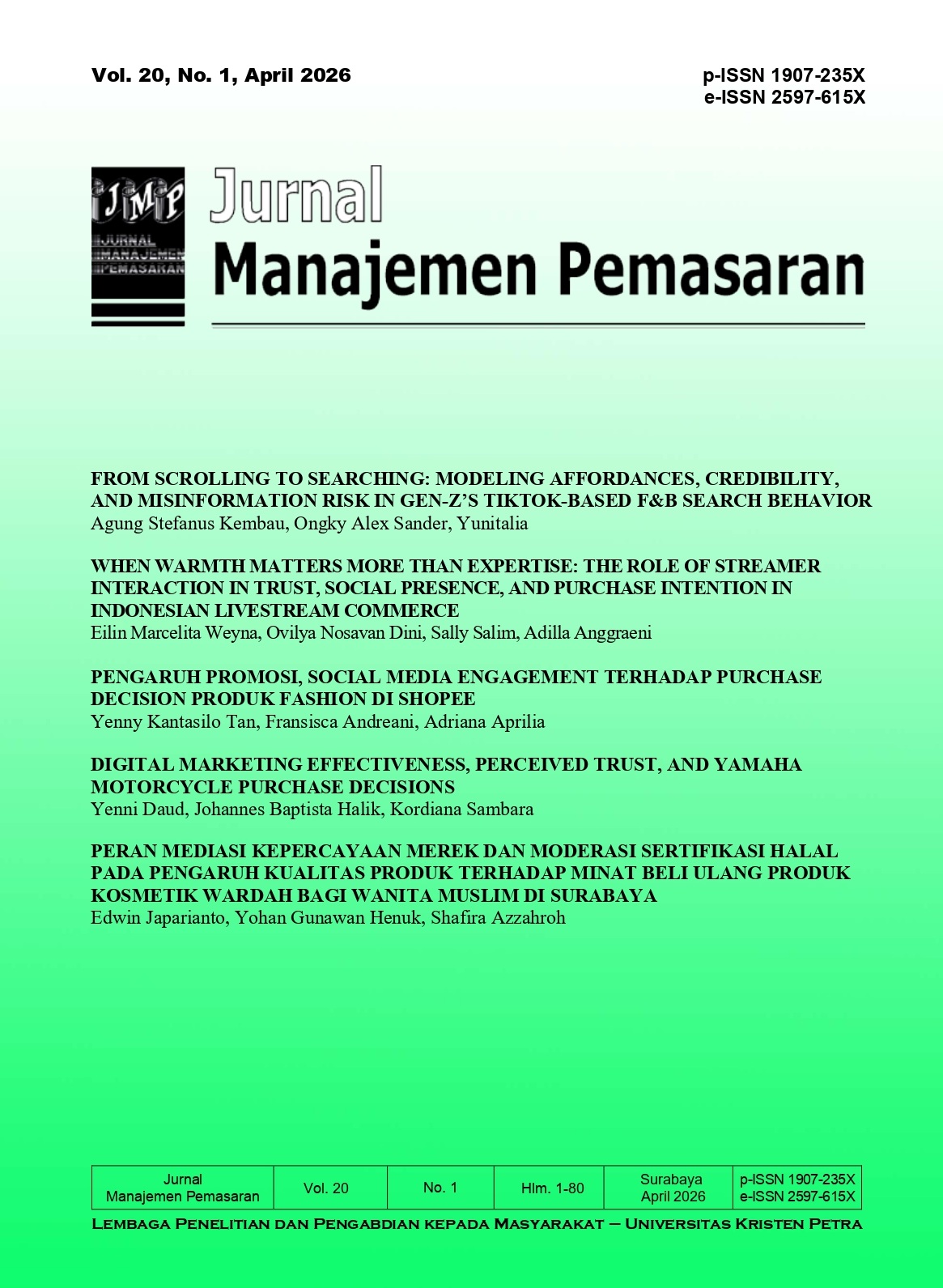
FROM SCROLLING TO SEARCHING
MODELING AFFORDANCES, CREDIBILITY, AND MISINFORMATION RISK IN GEN-Z’S TIKTOK-BASED F&B SEARCH BEHAVIOR
DOI:
https://doi.org/10.9744/pemasaran.20.1.1-14Keywords:
TikTok marketing, perceived affordances, perceived credibility, misinformation risk, Gen-Z consumer behaviorAbstract
TikTok increasingly functions as an experiential search environment for Indonesian Gen-Z, shaping how food and beverage information is evaluated and acted upon. This study examines how perceived affordances and perceived search value shape perceived credibility, and how credibility and search satisfaction, in turn, drive visit intention. It also tests whether perceived misinformation risk weakens the credibility–intention pathway. A cross-sectional survey of Gen-Z TikTok users in Greater Jakarta (N = 234) was analyzed using partial least squares structural equation modeling. Results show that search value (β = 0.35, p < .001) and affordances (β = 0.28, p < .001) increase credibility; credibility raises search satisfaction (β = 0.41, p < .001), and both credibility (β = 0.32, p < .001) and satisfaction (β = 0.37, p < .001) heighten visit intention. The model explains a substantial share of variance in visit intention (R² = 0.56) and exhibits predictive relevance. Moderation tests indicate that misinformation risk reduces the behavioral impact of credibility (β = −0.17, p = .008). The study contributes a coherent mechanism linking platform design and experiential value to credibility, satisfaction, and behavior, and identifies platform-level skepticism as a boundary condition for conversion. For managers, the findings imply that designing high-fit, low-friction discovery episodes and embedding transparent verification cues are essential to translate short video search into offline visits.
Downloads
References
Almoqbel, M. (2025). From an entertaining app to a search engine. Telematics and Informatics Reports, 16, 100195. https://doi.org/10.1016/j.teler.2025.100195
Barta, S., Belanche, D., Fernández, A., & Flavián, M. (2023). Influencer marketing on TikTok: The effectiveness of humor and followers’ hedonic experience. Journal of Retailing and Consumer Services, 70, 103149. https://doi.org/10.1016/j.jretconser.2022.103149 ResearchGate
Bhattacherjee, A. (2001). Understanding information systems continuance: An expectation-confirmation model. MIS Quarterly, 25(3), 351–370. https://doi.org/10.2307/3250921 Taylor & Francis Online
Brookbank, E. (2025). Is TikTok the new Google? How college students use TikTok to search for information. The Reference Librarian, 1–27. https://doi.org/10.1080/02763877.2024.2430885
Cervi, L. (2021). TikTok and Generation Z. Theatre, Dance and Performance Training, 12(2), 198–204. https://doi.org/10.1080/19443927.2021.1911791 Ecker Memory & Cognition Lab
Cheung, C. M. K., Lee, M. K. O., & Rabjohn, N. (2009). The impact of electronic word-of-mouth: The adoption of online opinions in online customer communities. Internet Research, 19(3), 229–247. https://doi.org/10.1108/10662240810883290 ResearchGate
Christian, M., Yulita, H., Gularso, K., & Sunarno, S. (2025). Applying UTAUT2 model elements to social media advertising features and purchasing intentions: An empirical study of young TikTok users in Indonesia. In Innovative and Intelligent Digital Technologies; Towards an Increased Efficiency (Vol. 2, pp. 145–157).
Christanti, C., & Kembau, A. S. (2024). Pengaruh strategi pemasaran konten dan afiliasi terhadap pembelian impulsif: Peran mediasi pemasaran viral dan kepercayaan. Modus, 36(2), 198–223. https://doi.org/10.24002/modus.v36i2.8787
DataReportal. (2025, January). Digital 2025: Indonesia. We Are Social & Meltwater. https://datareportal.com/reports/digital-2025-indonesia EconPapers
DeLone, W. H., & McLean, E. R. (2003). The DeLone and McLean model of information systems success: A ten-year update. Journal of Management Information Systems, 19(4), 9–30. https://doi.org/10.1080/07421222.2003.11045748 etasr.com
Diep, P. P. U., Lin, J., Papadamou, K., Zannettou, S., & De Cristofaro, E. (2025). Using TikTok as a search engine: Affordances, perceived value, and evaluation behaviors. Telematics and Informatics, 117, 102215.
Ecker, U. K., Lewandowsky, S., Cook, J., Schmid, P., Fazio, L. K., Brashier, N., … Amazeen, M. A. (2022). The psychological drivers of misinformation belief and its resistance to correction. Nature Reviews Psychology, 1(1), 13–29. https://doi.org/10.1038/s44159-021-00006-y Semantic Scholar
Erdmann, A., Arilla, R., & Ponzoa, J. M. (2022). Search engine optimization: The long-term strategy of keyword choice. Journal of Business Research, 144, 650–662. https://doi.org/10.1016/j.jbusres.2022.02.036 journalsiitmjp.com
Felix, A., Yurisca, D., Kembau, A. S., Sutrisno, J., & Maitri, F. (2024). Pemanfaatan TikTok dalam strategi pemasaran: Studi kasus Naughty Indonesia dan pelatihan tim pemasaran digital. Jurnal Abdimas Bina Bangsa, 5(1), 707–716. https://doi.org/10.46306/jabb.v5i1.1015 e-jurnal.jurnalcenter.com
Filieri, R. (2015). What makes online reviews helpful? A diagnosticity-adoption framework to explain informational and normative influences in e-WOM. Journal of Business Research, 68(6), 1261–1270. https://doi.org/10.1016/j.jbusres.2014.11.006 ScienceDirect+1
Finkelstein, D., Gonzales, L., Smith, K., & Johnson, M. (2025). Information manipulation on TikTok and its relation to content moderation. Frontiers in Psychology, 16, 1579234. https://doi.org/10.3389/fpsyg.2025.1579234
Hadji, B., & Degoulet, P. (2016). Information system end-user satisfaction and continuance intention: A unified modeling approach. Journal of Biomedical Informatics, 61, 185–193. https://doi.org/10.1016/j.jbi.2016.02.004
Hair, J. F., Hult, G. T. M., Ringle, C. M., & Sarstedt, M. (2022). A primer on partial least squares structural equation modeling (PLS-SEM) (3rd ed.). Thousand Oaks, CA: SAGE. (Tidak ada DOI buku) Link: https://us.sagepub.com/en-us/nam/a-primer-on-partial-least-squares-structural-equation-modeling-pls-sem/book268523
Hair, J. F., Risher, J. J., Sarstedt, M., & Ringle, C. M. (2019). When to use and how to report the results of PLS-SEM. European Business Review, 31(1), 2–24. DOI: 10.1108/EBR-11-2018-0203
Institute for Strategic Dialogue (ISD). (2025). How TikTok’s search engine algorithms reproduce societal bias. London: ISD. https://www.isdglobal.org
Kirkpatrick, C. E., et al. (2024). TikTok as a source of health information and misinformation. JMIR Infodemiology, 4(1), e54663. https://doi.org/10.2196/54663
Metzger, M. J., & Flanagin, A. J. (2013). Credibility and trust of information in online environments: The use of cognitive heuristics. Journal of Pragmatics, 59, 210–220. https://doi.org/10.1016/j.pragma.2013.07.012
Molem, A., Makri, S., & McKay, D. (2024). Keepin’ it reel: Investigating how short videos on TikTok and Instagram Reels influence view change. In Proceedings of the 2024 ACM SIGIR Conference on Human Information Interaction and Retrieval (CHIIR). https://doi.org/10.1145/3627508.3638341
Nieman Lab. (2022, July 13). Almost 40% of Gen Z is using TikTok and Instagram for search instead of Google, according to Google’s own data. https://www.niemanlab.org/reading/almost-40-of-gen-z-is-using-tiktok-and-instagram-for-search-instead-of-google-according-to-googles-own-data/
Rahayu, F. S., Nastiti, P., & Arthajanvian, T. (2025). The role of hedonic motivation in influencing TikTok use and how it relates to Generation Z characteristics. Advances in Human-Computer Interaction, 2025, 5971465.
Roberts, J. A., David, M., & Lin, X. (2025). An investigation of TikTok, Instagram Reels, and YouTube Shorts tech affordances. Cyberpsychology, Behavior, and Social Networking, 28(2), 101–110. DOI: indikasi 10.1089/cyber.2024.0456,
Shmueli, G., Sarstedt, M., Hair, J. F., Cheah, J., Ting, H., Vaithilingam, S., & Ringle, C. M. (2019). Predictive model assessment in PLS-SEM: Guidelines for using PLSpredict. European Journal of Marketing, 53(11), 2322–2347. https://doi.org/10.1108/EJM-02-2019-0189
Siani, A., Joseph, M., & Dacin, C. (2024). Susceptibility to scientific misinformation and perception of news source reliability in secondary school students. Discover Education, 3(1), 93.
Treem, J. W., & Leonardi, P. M. (2012). Social media use in organizations: Exploring the affordances of visibility, editability, persistence, and association. Communication Yearbook, 36, 143–189. https://doi.org/10.1080/23808985.2013.11679130
Wang, B., & Liu, J. (2024). Understanding users’ dynamic perceptions of search gain and cost in sessions: An expectation confirmation model. Journal of the Association for Information Science and Technology, 75(9), 937–956. https://doi.org/10.1002/asi.24935
Zeithaml, V. A. (1988). Consumer perceptions of price, quality, and value: A means–end model and synthesis of evidence. Journal of Marketing, 52(3), 2–22. https://doi.org/10.1177/002224298805200302
Downloads
Published
Issue
Section
License
Copyright (c) 2026 Agung Stefanus Kembau, Ongky Alex Sander , Yunitalia

This work is licensed under a Creative Commons Attribution 4.0 International License.
Jurnal Manajemen Pemasaran allows the author(s) to hold the copyright withour restrictions and retain the publishing rights without restrictions.